
The core European standard for fume hood design, face velocity, containment, alarm systems and safe operation.
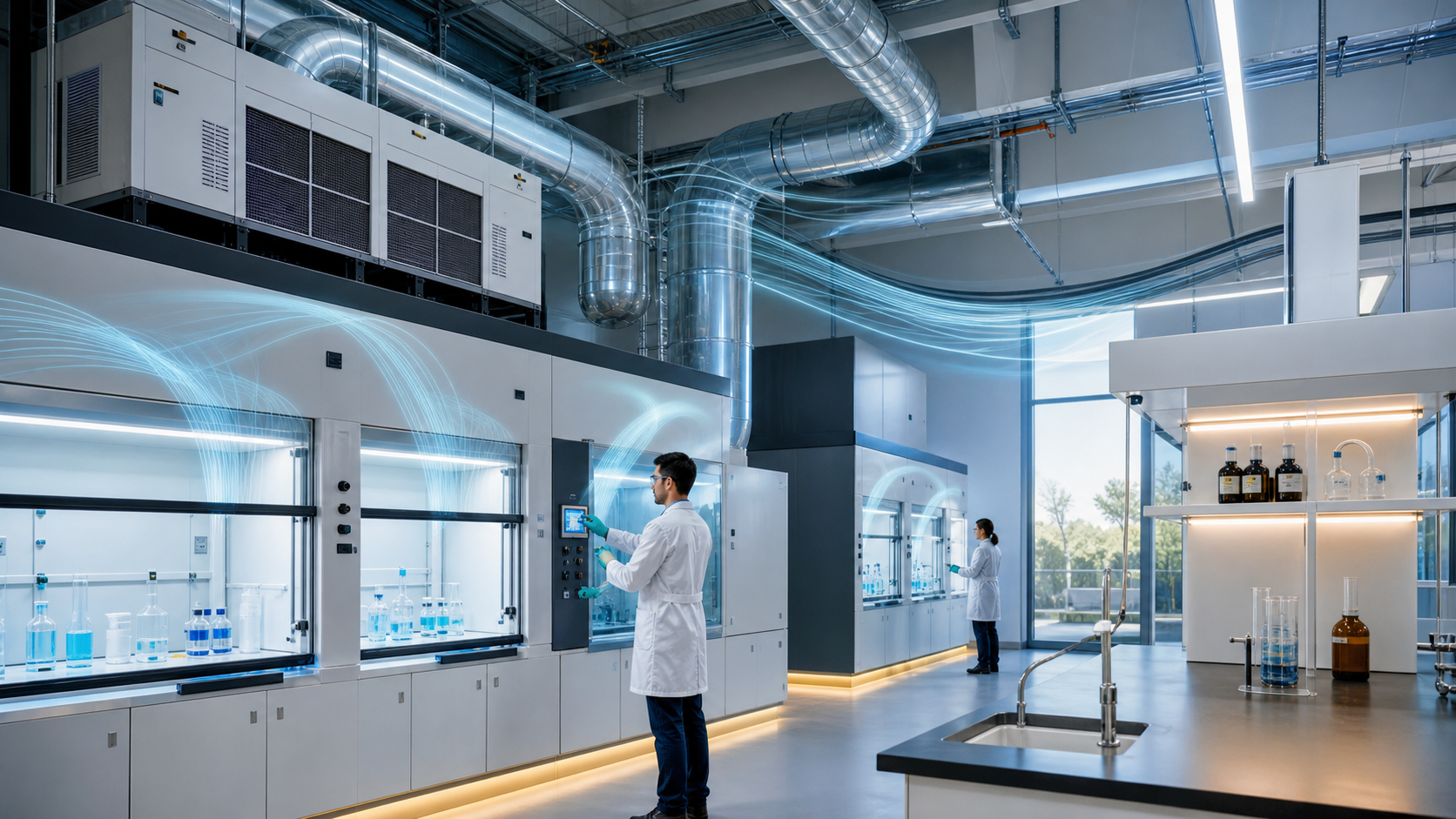
Helping your laboratory breathe
Safe, efficient and standards-compliant laboratory ventilation
A well-designed ventilation system limits chemical and biological exposure, protects equipment and sample integrity, improves energy efficiency and establishes an auditable safety infrastructure.
EN / ASHRAE Standards-based design and performance testing
6-12 ACH Air change targets based on risk level
30–50% Typical energy-saving potential with VAV
Compliance
EN and ASHRAE standards at the heart of design
Laboratory ventilation systems should be designed using internationally recognized frameworks for performance, containment, pressure cascading and fire safety rather than arbitrary preferences.
Covers performance requirements for biosafety cabinets and microbiological safety equipment.
An important North American test standard used to verify fume hood containment performance.
Provides engineering principles for air change rates, pressure cascading and energy efficiency.
Defines fire safety and ventilation requirements for laboratories working with flammable and hazardous chemicals.
Limits chemical and biological exposure
Exposure to chemical vapours, dust, aerosols and biological agents can cause serious health risks, from respiratory problems to chronic poisoning. Appropriate air change rates, pressure cascading and local exhaust systems protect staff.
Protects equipment stability and sample integrity
Humidity, temperature fluctuations and uncontrolled particle loads can cause calibration drift in chromatography systems, microscopes and precision balances. Well-designed climate control and filtration support repeatable measurement results.
Filtration technologies
The right filtration stages for each risk
Depending on the laboratory type, scrubbers, activated carbon and HEPA filtration stages are used individually or in sequence. The aim is to balance safety, emission control and operating costs.
Wet scrubbing systems
Neutralizes acidic, alkaline or corrosive vapours through chemical reactions. Plays a critical role in emission control and duct corrosion management in laboratories using highly concentrated inorganic chemicals.
Activated carbon filtration
Captures organic solvent vapours and odour-causing compounds through adsorption. A cost-effective solution for low-volume, variable chemical loads; filter saturation should be monitored regularly.
HEPA filtration
Captures 0.3-micron particles with 99.97% efficiency. Can be used in supply or exhaust air for biosafety cabinets, isolators and areas sensitive to particle contamination.
Operating costs
The choice of VAV or CAV directly determines energy performance
CAV systems operate predictably at a constant airflow, but maintain high flow even when the laboratory is unoccupied. VAV systems adjust airflow in real time using fume hood sash position, room occupancy sensors and gas detection data.
Correctly sized VAV infrastructure can deliver significant long-term operating savings without compromising safety.
CAV operating airflowConstantly high
VAV during low-risk periods30–50% savings
System approach
The right infrastructure starts with risk assessment
Considering chemical and biological risks, intensity of use, pressure relationships, equipment sensitivity and budget objectives together produces a sustainable solution tailored to the laboratory.
1
Define the risk profile
Chemical, biological and particle-related risks are classified by area.
2
Establish the airflow strategy
Air change rates, local extraction, pressure cascading and single-pass air requirements are defined.
3
Select the filtration
Scrubber, activated carbon and HEPA stages are sized according to the risk type.
4
Integrate automation
Safe minimum airflow is managed through sash sensors, room pressure controllers and BMS integration.
Identify the right ventilation infrastructure for your laboratory
Compare products and systems by considering your risk profile, intensity of use and budget objectives together.